

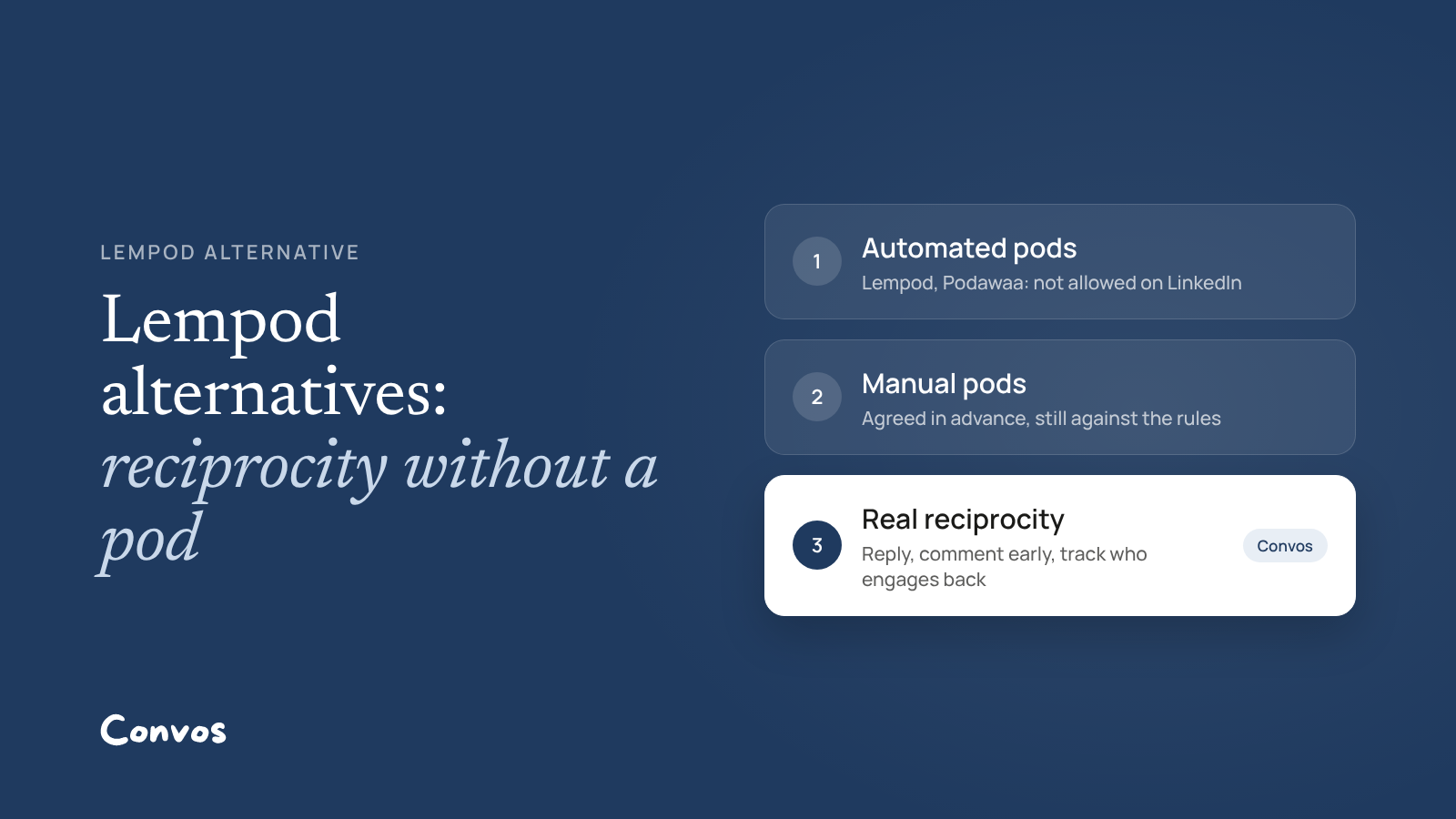
In short: the best lempod alternative in 2026 is not another pod. LinkedIn now says engagement pods “erode trust and are not allowed”, removes pod groups and limits automated comments, so any tool that trades likes and comments on autopilot carries the same risk lempod does. What replaces pod reciprocity is the real kind: reply to every comment on your posts, comment early and well on a short list of people, and track who engages back. You can do that by hand, or with a tool that organises it without acting for you.
Key takeaways
- LinkedIn confirmed in March 2026 that pods are not allowed and that automated comments from extensions, scripts or third-party tools are not allowed either.
- Since February 2026, automated comments are removed from the “Most relevant” ranking, can be limited to the commenter’s direct connections, and repeat offenders are restricted.
- Pod comments look good at first: in MagicPost’s study of 687,000 posts, early pod comments lifted views by 31% at one hour but cut final reach by 6%.
- Other pod tools such as Podawaa work on the same principle, so they are not a safer lempod alternative.
- Real reciprocity is a routine, not a network: reply, comment in the first hour, keep a list of people who engage back.
Why people look for a lempod alternative now
Lempod is a Chrome extension that runs automated engagement pods: members post into a pod and the other members’ accounts like and comment automatically. For years it was the shortcut to early engagement. The problem in 2026 is that LinkedIn has named this exact practice.
In its March 2026 statement, LinkedIn wrote that engagement pods “erode trust and are not allowed on LinkedIn”, that pod groups have been removed and members contacted, with warnings that include restrictions and the loss of Top Voice status. The same post says automated comments, whether from a browser extension, a script or a third-party tool, are not allowed (LinkedIn News, 13 March 2026).
A month earlier, LinkedIn’s VP of Product Gyanda Sachdeva described three measures against comments posted “without any human oversight or review”: removal from “Most relevant”, visibility limited to direct connections, and restrictions for repeat offenders. She also said “thousands” of updates were boosted by pods every day (Social Media Today, 16 February 2026).
Do engagement pods still work?
Less than the dashboard suggests. Detection is behavioural: LinkedIn’s VP of Trust Product, Oscar Rodriguez, told Forbes the system looks for “concentrated activity, the same members at the same times within the same timeframes”, which is a fair description of how a pod behaves (LigoSocial, quoting Forbes). LinkedIn’s Professional Community Policies also ask members not to “agree with others ahead of time to like or re-share each other’s content”.
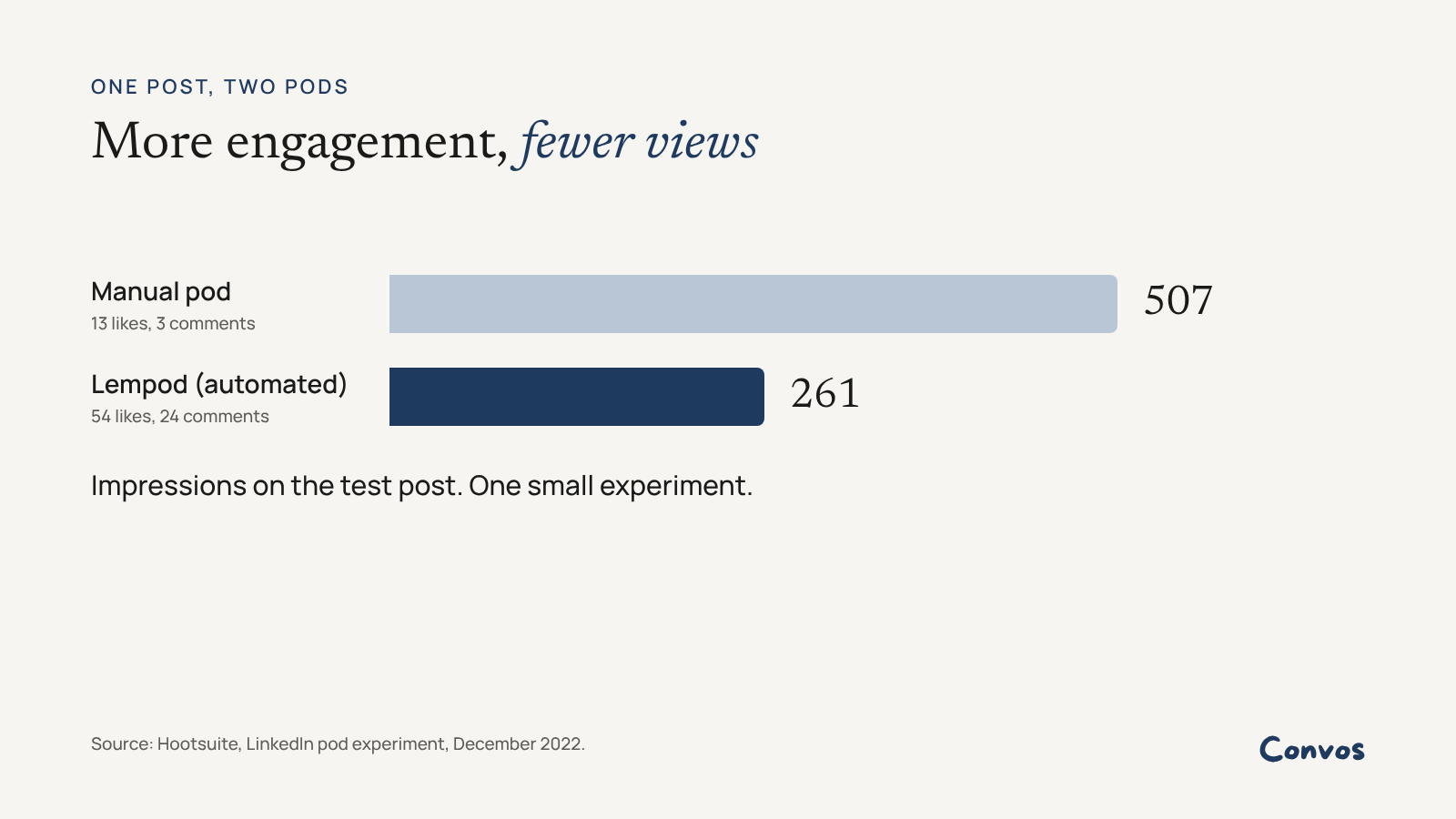
The numbers point the same way. Hootsuite ran a small pod experiment: a manual pod produced 13 likes, 3 comments and 507 impressions, while lempod produced 54 likes and 24 comments but only 261 impressions, with comments its author described as generic (Hootsuite, December 2022). It is one small test, but more engagement for fewer views is the pattern you would expect if the algorithm discounts pod activity.
At scale, MagicPost’s study of 687,000 posts from 16,000 creators (June 2025 to September 2026) found that early pod comments lifted views by 31% at one hour, but final reach ended 6% lower (MagicPost). Vendor data, so read it as a direction rather than a law; the direction is not flattering for pods.
Lempod alternatives compared
| Option | How it works | Risk to your account | Cost (October 2026) |
|---|---|---|---|
| Other automated pods (Podawaa and similar) | Extension trades likes and comments automatically | Same as lempod: pods and automated comments are not allowed | Varies |
| Manual pods (chat groups) | Members agree to engage on each other’s posts | Lower than automation, but still against the Professional Community Policies | Free |
| AI comment tools | Software writes or posts comments for you | Automated comments are demoted and can be limited | Typically paid plans |
| A manual reciprocity routine | You reply, comment early, track who engages back | None from LinkedIn’s rules | Free, about 15 minutes a day |
| An engagement organiser (such as Convos) | A tool lines up posts and replies; you write and send | Low: nothing is posted without your click | Free plan, then paid |
The honest summary: switching from lempod to another pod tool changes the logo, not the risk. The real alternatives are in the last two rows.
What replaces pod reciprocity without coordination
Pods solved a real problem: early engagement from people who will actually show up. You can get that without anyone agreeing to anything in advance.
Reply to every comment on your own posts
This is the highest-return habit available. Buffer’s analysis of 72,000 posts from around 25,000 accounts found that posts where the author replies to comments get about 30% more engagement, and 83% of profiles benefit (Buffer notes it is a correlation, not proof of cause) (Buffer, 4 December 2025). Replies also start conversations under the post, and reader-to-reader replies can lift a comment’s reach up to 2.4 times according to AuthoredUp’s dataset of around a million posts (Taplio).
Comment early on a short list of people
A pod guarantees early comments on your posts. The organic version is being early on other people’s. LinkHub’s study of 657,722 comments found that a comment in the first half hour earns about four times the impressions of the same comment a day later (via Taplio). Pick 20 to 30 people who matter to your work, check their new posts once a day, and write one real sentence about what they said.
Track who engages back
This is the part pods faked. Koka Sexton’s 2026 report on 2,279 posts from 246 B2B creators found that over 90% of people who engage with a post never return (Koka Sexton). Reciprocity is rare, which is exactly why it is worth noticing. Keep a simple note of who comments back on your posts and spend more of your time on them.
Write comments people actually read
ContentIn’s analysis of 250,000 comments from 5,500 users found that 41% get zero engagement (ContentIn, 16 May 2026). Generic praise is the main culprit. Add an experience, a number from your own work or a precise question; that is also the kind of comment that no automation can fake convincingly.
Where a tool helps, and where it should stop
The routine above takes discipline more than time. If you want help, choose a tool that organises the work and leaves the writing and the sending decision to you. Convos does exactly that: its daily queue gathers the new posts from your lists and the comments waiting for a reply, marks who comments back with a coloured dot, and sends only what you wrote, from your own browser. There is no AI writing and no pod.
If you want to compare more options, our guide to the best LinkedIn engagement tools sorts them by job, and the Taplio alternatives page covers the writing side.
The bottom line
Lempod made early engagement feel automatic. In 2026 that automation is the problem LinkedIn is solving. The alternative that holds up is slower and more human: answer your commenters, show up early for the people you care about, and keep track of who shows up for you. It costs about 15 minutes a day, and every like and comment it earns is real.